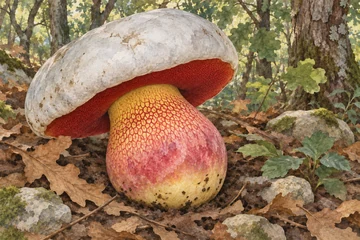
Penny bun: apical reticulation and tubes visible in section
The penny bun's often paler margin, pale reticulation and white flesh must be read together with the porous underside.
Margin and reticulation
The brown cap often has a paler margin. The robust stem bears pale reticulation mainly in its upper part. A lumpy texture or shadow must not be confused with this reticulation.
Tubes are continuous structures
The section shows tubes beneath the flesh with openings facing downwards. The underside is neither a structureless foam layer nor a set of gills. The flesh remains white in the account's concept.
The name Bordeaux does not restrict the region
The taxon has observations beyond Bordeaux; its calendar and associated trees must remain linked to the territory. An international scientific account gives no fixed worldwide season. The MycoWiki account details species anatomy. MycoWiki.
Related guides and articles
Show 20 more articles

- Cep soil: what the map and terrain say separately
- Porcini season: a calendar for several species
- Trees associated with porcini: proximity, stand and evidence
- Porcini nutrition: reading the Ciqual 2025 values
- Recognising porcini
- Porcini and boletes: a subset, not two opposing groups
- Slimy porcini: wet surface or deterioration?
- Growing porcini: root association and production are two aims
- Porcini prices: species, provenance and cost after sorting
- A yellow cep
- Freezing ceps: prepare portions that are easy to cook
- Storing ceps: track the condition of stem, cap and tubes
- Must ceps be peeled? Cleaning without removing the whole cuticle
- Cep powder: start with an identified dried product
- Drying ceps: prepare inspectable slices
- Cleaning ceps: examine the interior too
- Cooking fresh ceps: distinguish sorting, cutting and browning
- Removing cep tubes: a choice of condition and texture
- Raw ceps: gastronomic reputation and health recommendation
- An old cep: flesh condition matters more than size
 Sources and review