Contents
 Contents
Should you look for mushrooms after rain?
Rain can change local conditions, but its effect depends on what came before, where it fell and how the habitat retains or loses moisture.
Abandon the universal countdown
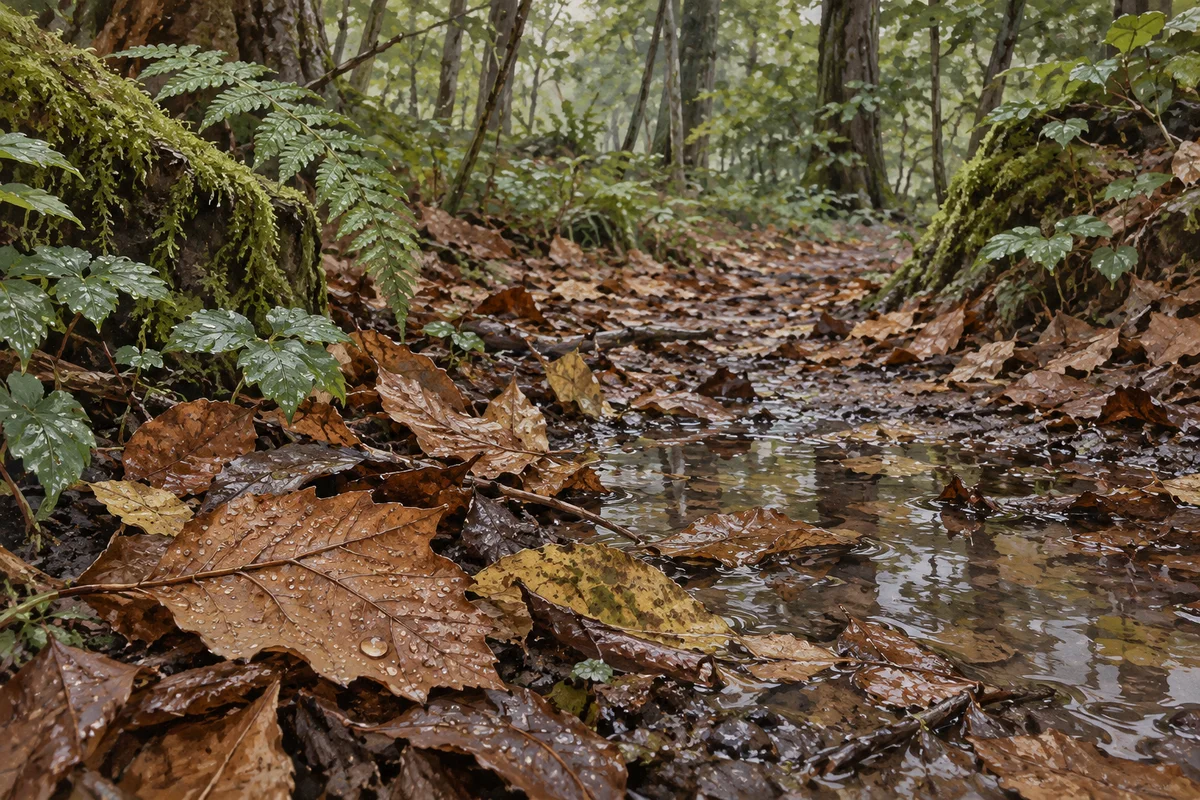
There is no single reliable number of days after rain that works for every fungus, season and habitat. Rainfall varies in intensity and distribution, and the ground responds differently depending on prior dryness, canopy, slope and exposure. Visible fruiting also depends on biological processes that a weather map does not observe directly. Use rain as one piece of context, not as a timer. Any rule promising a certain harvest after a fixed delay creates confidence that the evidence cannot support.
Read the event and what preceded it
Check radar or measured weather information to understand whether rain reached the intended sector, then consider the broader sequence. A short event after a prolonged dry period may not make the ground comparable to a consistently moist site, while nearby valleys can receive different amounts. MycoRadar brings signals together, but local verification remains necessary. Do not infer soil moisture from a wet road or assume an entire forest received the same conditions because rain fell at home.
- Check where the rain actually fell.
- Review the preceding dry or wet period.
- Compare sheltered and exposed terrain.
- Treat the result as context, not a countdown.
 Check where the rain actually fell.
Observe how the habitat holds moisture
In the field, compare leaf litter, moss, open ground, compacted paths and sheltered areas without assuming they behave alike. Describe visible or tactile conditions carefully and avoid digging merely to confirm an expectation. A local patch may remain dry under dense cover while another retains moisture, yet neither observation proves that a particular mushroom should appear. The purpose is to improve your understanding of the site and explain why two nearby map cells may lead to different walking experiences.
Keep weather safety separate from opportunity
Recent or continuing rain can also affect path grip, streams, visibility and exposure. Consult official forecasts and choose a route that remains suitable for the group. Never interpret a favourable mushroom signal as permission to enter a storm, cross difficult ground or ignore closures. If conditions are unsafe, postpone the visit. A later observation made calmly is more valuable than a hurried search shaped by fear of missing an imagined, short-lived opportunity.
Sources and review

Related guides
Map context

Read the conditions
A condition matters only in context. Combine several signals and verify them on the ground instead of treating one indicator as a forecast of mushrooms.
Timing a visit

Choose when to go
There is no single perfect day. A useful decision combines recent conditions, the place you will visit and a realistic opportunity to observe it well.
Score explained

Understand the score
The score compresses several contextual signals so that sectors can be compared. It is not a percentage chance, inventory or food-safety rating.