Contents
 Contents
How to understand the MycoRadar mushroom score
The score compresses several contextual signals so that sectors can be compared. It is not a percentage chance, inventory or food-safety rating.
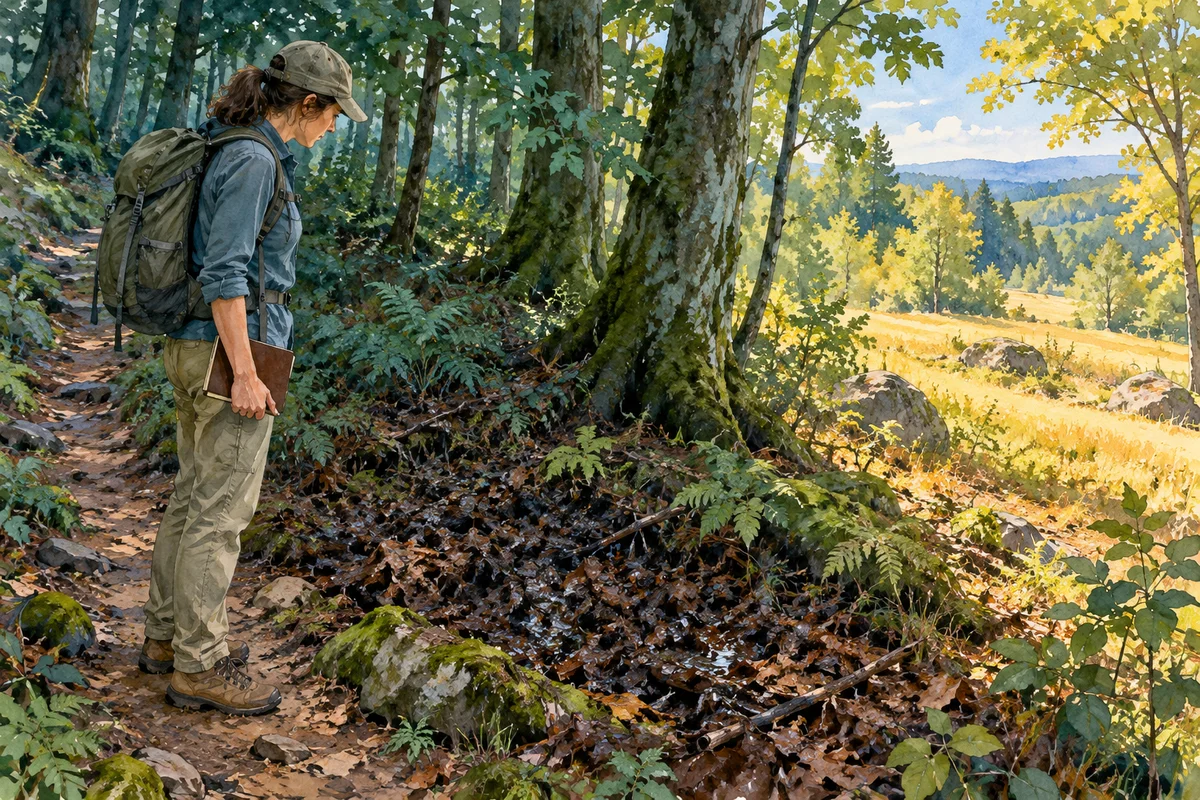
Know what the score represents
MycoRadar combines available contextual inputs to help rank or compare areas for observation. The score describes how those inputs align within the product's method; it does not count mushrooms, observe the forest floor or calculate the probability of finding a named species. Treat it as a planning shorthand that should always be opened and interpreted through its contributing signals. A larger number can guide attention, but it cannot convert uncertainty into presence, abundance or edibility.
Inspect the reasons behind the number
Before choosing a sector, review the available condition, season, terrain, habitat and observation context rather than comparing numbers alone. Two equal scores may arise from different combinations and support different field questions. One area may be easier to access or offer a more readable habitat transition even when its headline score is lower. The best choice is not always the maximum value. It is the sector whose context, route and uncertainty you can understand and verify safely.
- Open the score breakdown.
- Compare why two sectors received their values.
- Add route safety to the decision.
- Choose a field question, not only a maximum number.
 Open the score breakdown.
Avoid false precision
A score displayed with a clear number can feel more exact than the underlying landscape. Input layers operate at different scales, conditions change and local features may not be represented. Small differences should not be treated as proof that one side of a path contains mushrooms and the other does not. MycoRadar communicates a modelled comparison, not a direct measurement at each footstep. Use broad patterns and the explanation panel, then let the ground supply the missing detail.
Calibrate your use, not the biology
After a visit, note whether the sector was accessible, readable and consistent with the displayed context. Do not label the score correct only because you found something or wrong because you did not. A single outing cannot validate the biological model, and visible fruiting is not guaranteed. Use repeated notes to improve how you select routes and questions.
Sources and review

Related guides
Map literacy

Read the map
The map organises broad signals for comparison. Its job is to help you choose where to observe, not to reveal mushrooms hidden on the ground.
Map context

Read the conditions
A condition matters only in context. Combine several signals and verify them on the ground instead of treating one indicator as a forecast of mushrooms.
Weather interpretation
After the rain
Rain can change local conditions, but its effect depends on what came before, where it fell and how the habitat retains or loses moisture.