Norcia black truffle
The black truffle of Norcia is also that of Périgord. In Umbria, its history is played out between the villages of Valnerina, the roots of trees and a perfume that reveals its presence underground.
A name that goes beyond the city

Cascia, Preci, Scheggino, Vallo di Nera: these municipalities are also among the production areas of nero pregiato in Umbria. With Norcia and Spoleto, they draw a geography broader than the name displayed on a stall. All here speak of Tuber melanosporum.
In 1951, the black truffle festival was not yet held in the streets of Norcia. Its setting was Castellina, the Vignola palace. The Pro Nursia archives recount this passage from the palace to the streets of the city: the truffle emerged from the undergrowth to become a public affair.
Limestone and clayey soils are part of its Umbrian environments. Oaks and holm oaks, associated with truffles in the region, give the landscape an underground dimension: their small roots are the mushroom's partners.
A life shared with trees

The truffle does not live alone. Its mycelium, a network of filaments, is associated with the small roots of the tree. This association is called mycorrhiza. The ball sought underground is the reproductive part of the mushroom: its fruiting body.
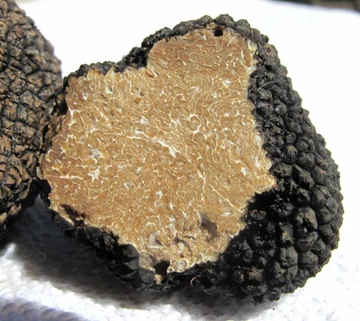
When ripe, the interior becomes dark to purplish-black, crossed with fine white veins. The exterior has small warts. The marbled pattern of the flesh corresponds to a very real organization: fertile zones, containing the spores, alternate with sterile zones which form the veins.
The perfume, well before the plate

When the truffle ripens, its smell attracts animals who spot it in the ground. Those who eat it contribute to the dispersal of its spores. The perfume thus intervenes in the reproduction of the mushroom, long before becoming a table pleasure.
It is also this olfactory signal that the search dog follows. Work with animals and knowledge of the field are transmitted between practitioners: the Italian cerca has belonged to UNESCO's intangible cultural heritage since 2021. Stories, local names and learning with dogs are part of this orally transmitted knowledge.
 Sources and review